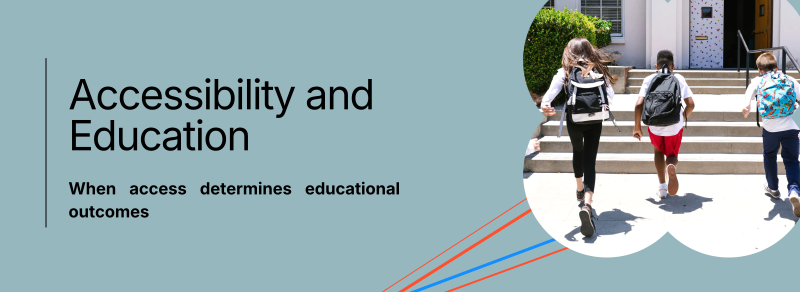
Accessibility and Education: When Access Determines Educational Outcomes

Education rarely fails because of its content. It fails because people cannot access it. What should theoretically be accessible to everyone is often limited in practice by something very concrete: information that cannot be used. Accessibility is therefore not merely a technical detail, but a prerequisite for genuine participation.
When documents block access
Scripts, presentations, forms, and official notices form the foundation of learning and organization in everyday education. Yet this is precisely where the first obstacles arise.
Unstructured PDFs, scanned content, or a lack of semantic markup prevent screen readers from correctly interpreting content. Navigation is nearly impossible, and content remains incomprehensible or even invisible.
For many, this is a quality issue. For others, it means no access to education.
Dependence instead of independence
When content is inaccessible, it creates dependency. Information must be adapted, explained, or provided after the fact. Learners rely on support instead of grasping the content on their own.
This changes not only the learning process but also the role of those involved. Independent work turns into a constant search for solutions.
Lack of accessibility results in costs
Accessibility is often viewed as an extra burden. In reality, the greater costs arise where it is lacking.
When people do not have equal access to education, the long-term consequences are significant:
- Qualifications are not attained
- Potential remains untapped
- Entry into the labor market is made more difficult
- Dependence on support systems increases
This results not only in individual disadvantages but also in costs for society as a whole.
At the same time, a lack of accessibility leads to direct additional expenses: content must be retroactively adapted, support and custom solutions become necessary, and processes become inefficient and difficult to scale.
Resources are not directed toward accessibility itself, but toward overcoming existing barriers.
Conclusion
Accessibility in education is not an optional extra.
It determines whether people can use content independently or not. And it determines whether systems function efficiently or generate unnecessary costs. As long as documents remain inaccessible, education will remain limited for many.
Not because the content is missing, but because access is missing.